GEO vs. SEO vs. AEO: what's actually different, and what to do about it
Generative engine optimization, answer engine optimization and SEO overlap far more than the hype suggests. Google itself says the same fundamentals apply to its AI features. But a few things really are different when an AI writes the answer, and those are worth getting right.

By Nouman Sabir, AI search & SEO specialist
Updated · 6 min read

The short answer
- SEO is about ranking in search results. AEO is about being the direct answer (featured snippets, voice, AI Overviews). GEO is about being cited or recommended inside AI-generated answers from ChatGPT, Gemini, Perplexity and Copilot.
- They share one foundation: crawlable pages, helpful content, clear entity information and a strong reputation. Google says no special optimization is needed for its AI features beyond normal SEO best practices.
- What changes is emphasis: direct answers near the top, specific facts and numbers, consistent information about your business everywhere, and mentions on sites the AI trusts.
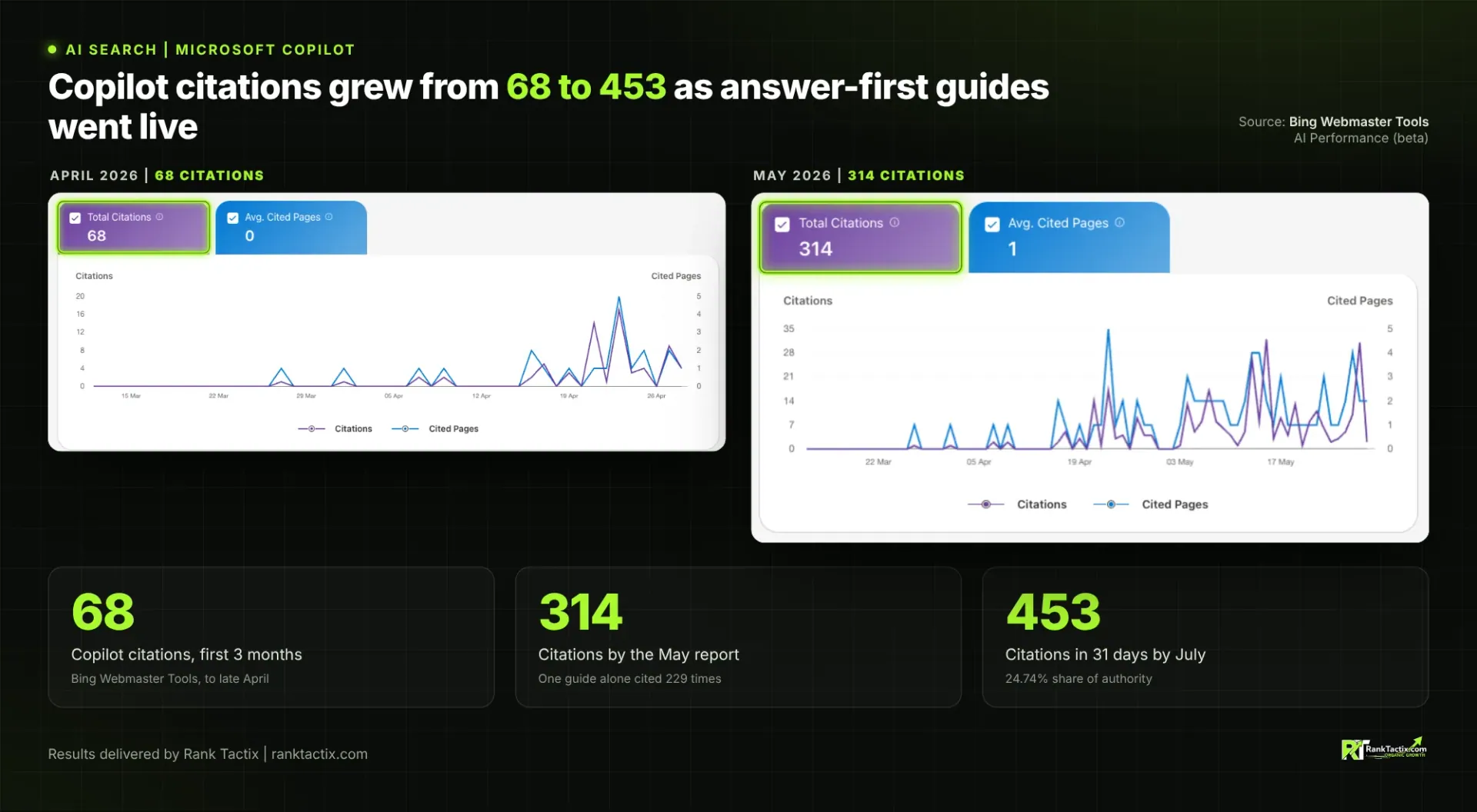
- For one B2B client, that approach produced 12.2K impressions inside Google's AI features and grew Copilot citations from 68 to 453 in a few months.
SEO, AEO and GEO in plain English
| SEO | AEO | GEO | |
|---|---|---|---|
| Stands for | Search engine optimization | Answer engine optimization | Generative engine optimization |
| Goal | Rank pages in search results | Be the direct answer to a question | Be cited, quoted or recommended in AI-written answers |
| Where it shows | Google and Bing results, the map pack | Featured snippets, People Also Ask, voice assistants, AI Overviews | ChatGPT, Gemini, Perplexity, Copilot, Google AI Overviews and AI Mode |
| Success looks like | Rankings, clicks, calls | Your answer shown first | Your brand named or your page linked as a source |
| How you measure it | Search Console, analytics, rank tracking | Snippet tracking, Search Console | Prompt testing, AI citation reports, referral traffic from AI tools |
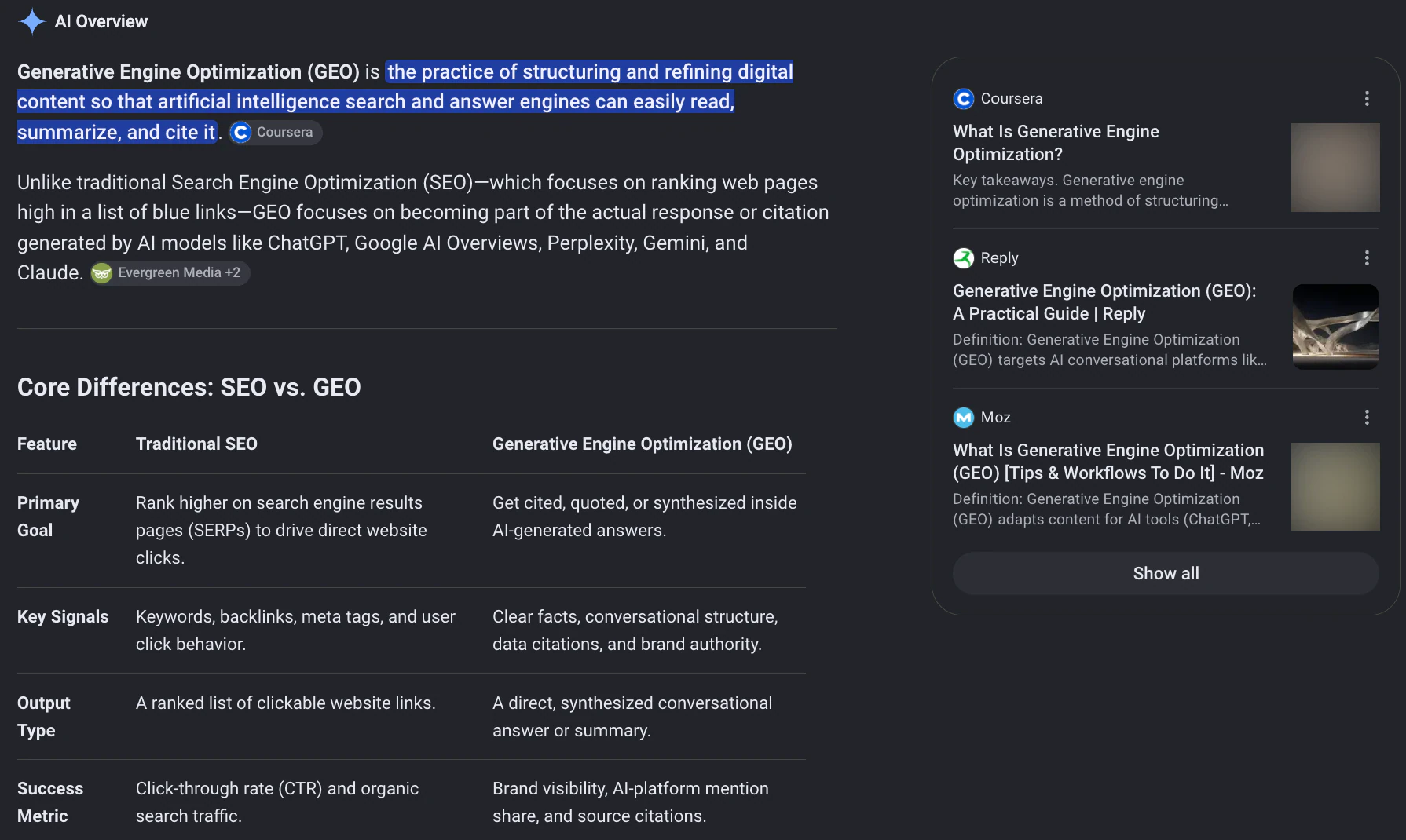
The term GEO comes from a 2023 research paper by Aggarwal and colleagues, which tested how page changes affect visibility in AI-generated answers. They found that adding citations, quotations and statistics could raise a source's visibility in those answers by up to 40% in their tests. AEO is older and grew out of featured snippets and voice search. In everyday use, people often say GEO and AEO interchangeably.
What stays the same
Google's documentation on AI features says you don't need special optimization to appear in AI Overviews or AI Mode, and that the same SEO best practices apply: let Google crawl your pages, make content easy to find through internal links, give a good page experience and write helpful, people-first content. Most AI assistants also lean on search indexes to find current sources, so pages that aren't indexed or rank nowhere rarely get cited.
- Pages need to be crawlable and indexed. If Google and Bing can't read them, AI tools built on their indexes can't either.
- Helpful, original content still wins. Thin pages written to hit a keyword don't get quoted.
- Reputation matters. Reviews, links and mentions on trusted sites feed both rankings and AI recommendations.
What changes when AI writes the answer
1. Answer first, then explain
AI tools pull short, self-contained passages. Put the direct answer in the first sentence or two under each heading, then the detail. "The NEC limits conduit fill to 40% when a run has three or more conductors" is quotable; a paragraph of preamble isn't.
2. Specifics beat adjectives
Numbers, prices, standards, named methods and real examples give an AI something to cite. "Fast, reliable service" gives it nothing. This matches what the GEO paper found about statistics and citations.
3. Your business described the same way everywhere
AI assistants build a picture of your business from your site, your Business Profile, directories, reviews and articles. If your services, locations and name match across all of them, you're easier to recommend. Organization schema and a consistent Business Profile help here.
4. Be mentioned where the AI looks
When someone asks ChatGPT for the best roofer or IT provider in a city, the answer often draws on review sites, directories, local news and "best of" lists, not just company websites. Being present and well reviewed on those sources is part of GEO.
5. Let AI crawlers in
OpenAI documents separate crawlers: OAI-SearchBot finds pages for ChatGPT search results, and GPTBot collects training data. You can allow the first and block the second. Check that your robots.txt or firewall isn't blocking the search crawlers you want; my robots.txt generator has presets for each.
What this looked like for a real client
Chicago Network Solutions is a B2B low-voltage contractor. From March 2026 we built 88 pages, including 13 answer-first guides, fixed the schema, rebuilt the Business Profile and made the business description consistent across 43 citations. We didn't write anything special "for AI". We wrote direct, specific pages for the questions commercial buyers ask.
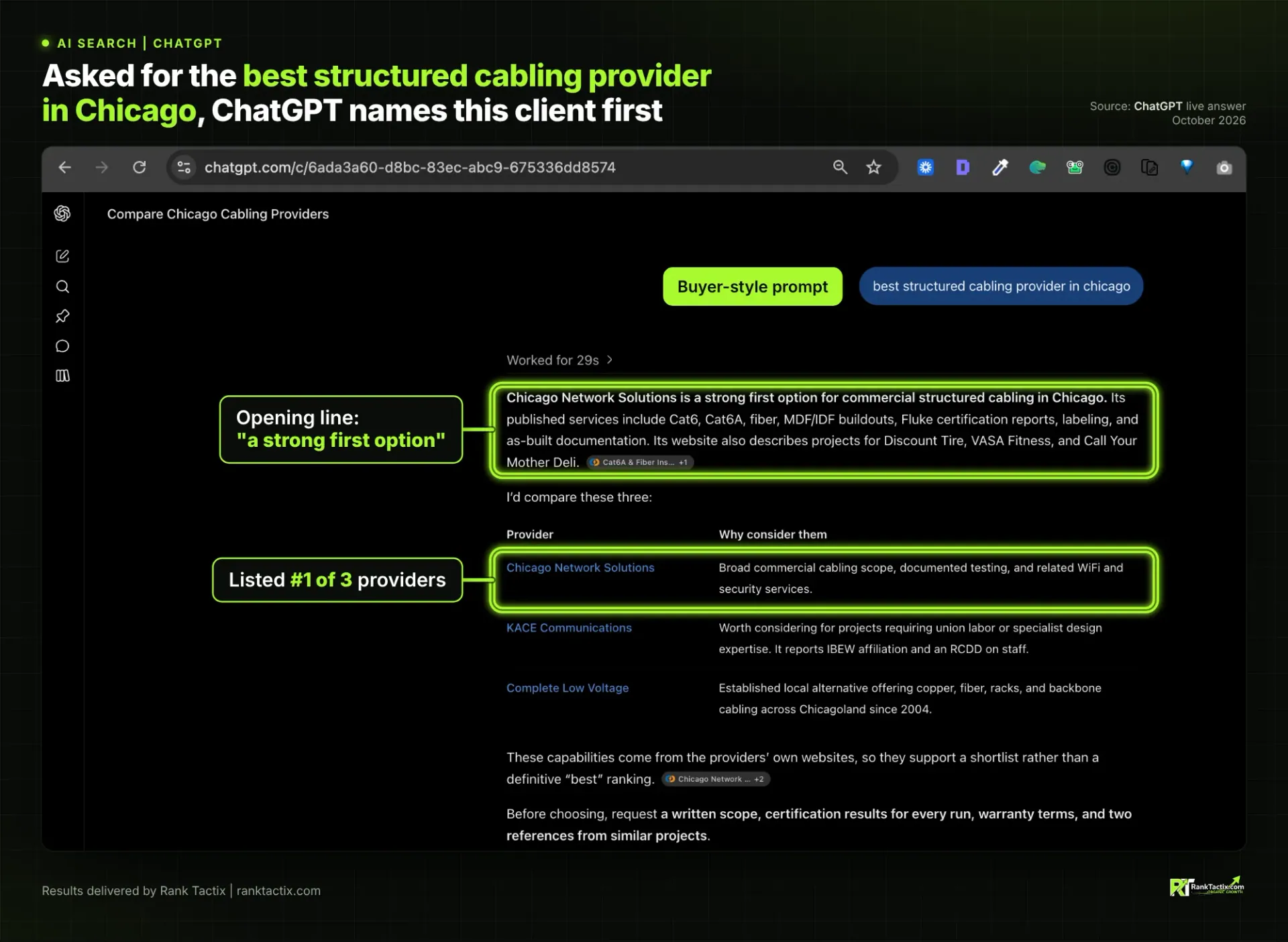
Within about seven months the site had 12.2K impressions inside Google's generative AI features, and ChatGPT named the company first when asked for the best structured cabling provider in Chicago. The full case study has the month-by-month timeline.
Where to start
- 1Check the basics: your important pages are indexed in Google and Bing, and AI search crawlers aren't blocked.
- 2Ask ChatGPT, Gemini and Perplexity the questions your customers ask, such as "best [service] in [city]". Note who gets named and which sources are cited.
- 3Rewrite your main service pages so each section opens with a direct, specific answer.
- 4Make your business details consistent across your site, Business Profile and the directories AI tools cite for your industry.
- 5Publish a few answer-first guides on the questions buyers ask before they hire someone like you.
- 6Track it: Search Console's reports, Bing's AI performance report and referral traffic from chatgpt.com and perplexity.ai in your analytics.
For the step-by-step version focused on recommendations, read how to get your business recommended by ChatGPT.
One thing you don't need: a special AI file. My guide to llms.txt covers what Google has said about it. B2B companies can see the approach applied to a full site in the B2B SEO strategy guide.
Google's newest surfaces are covered in their own guides: Google AI Mode, ranking in AI Overviews and answer engine optimization.
Frequently asked questions
Is GEO replacing SEO?
No. GEO builds on SEO. AI assistants find and trust sources largely through the same signals search engines use, so a site with weak SEO rarely gets cited by AI.
What is the difference between AEO and GEO?
AEO aims to be the direct answer in search features like featured snippets and voice results. GEO aims to be cited or recommended inside AI-generated answers. In practice the work overlaps heavily and many people use the terms interchangeably.
Do I need a separate GEO strategy?
You need a few extra habits rather than a separate strategy: answer-first writing, specific facts, consistent business information and presence on the sites AI tools cite for your industry.
How do I measure GEO results?
Test key prompts monthly across the main AI tools, check Search Console and Bing Webmaster Tools, and watch referral traffic from AI tools in your analytics.
Does llms.txt help with GEO?
It's a proposal, and the major AI search engines haven't confirmed they use it. It doesn't hurt to add, but it won't make up for weak content or poor visibility.
Sources
- AI features and your website, Google Search Central
- GEO: Generative Engine Optimization (Aggarwal et al., 2023), arXiv
- Overview of OpenAI crawlers, OpenAI
- Creating helpful, reliable, people-first content, Google Search Central
- The /llms.txt file proposal, llmstxt.org
Written by Nouman Sabir
Nouman Sabir is an AI search and local SEO specialist with 5+ years of hands-on work across 100+ websites, from contractors and law firms to SaaS and Shopify stores. He is Top Rated on Upwork with a 100% Job Success Score and 44 client reviews. Everything here comes from client work he has done or data he pulled himself.