
How to get your business recommended by ChatGPT
When someone asks ChatGPT for the best IT company or roofer in their city, it names two or three businesses. You can't pay to be one of them. I've done this for a real client, and these are the steps, what ChatGPT seems to rely on, and how to check where you stand today.

By Nouman Sabir, AI search & SEO specialist
Updated · 6 min read
The short answer
- ChatGPT recommends businesses it can find in its search results and describe with confidence: clear services, a clear location and a consistent reputation across the web.
- Allow OpenAI's search crawler (OAI-SearchBot), get your key pages indexed in Bing and Google, and write pages that answer buyers' questions directly.
- Make your business details match everywhere, and be present and well reviewed on the directories and lists ChatGPT cites for your industry.
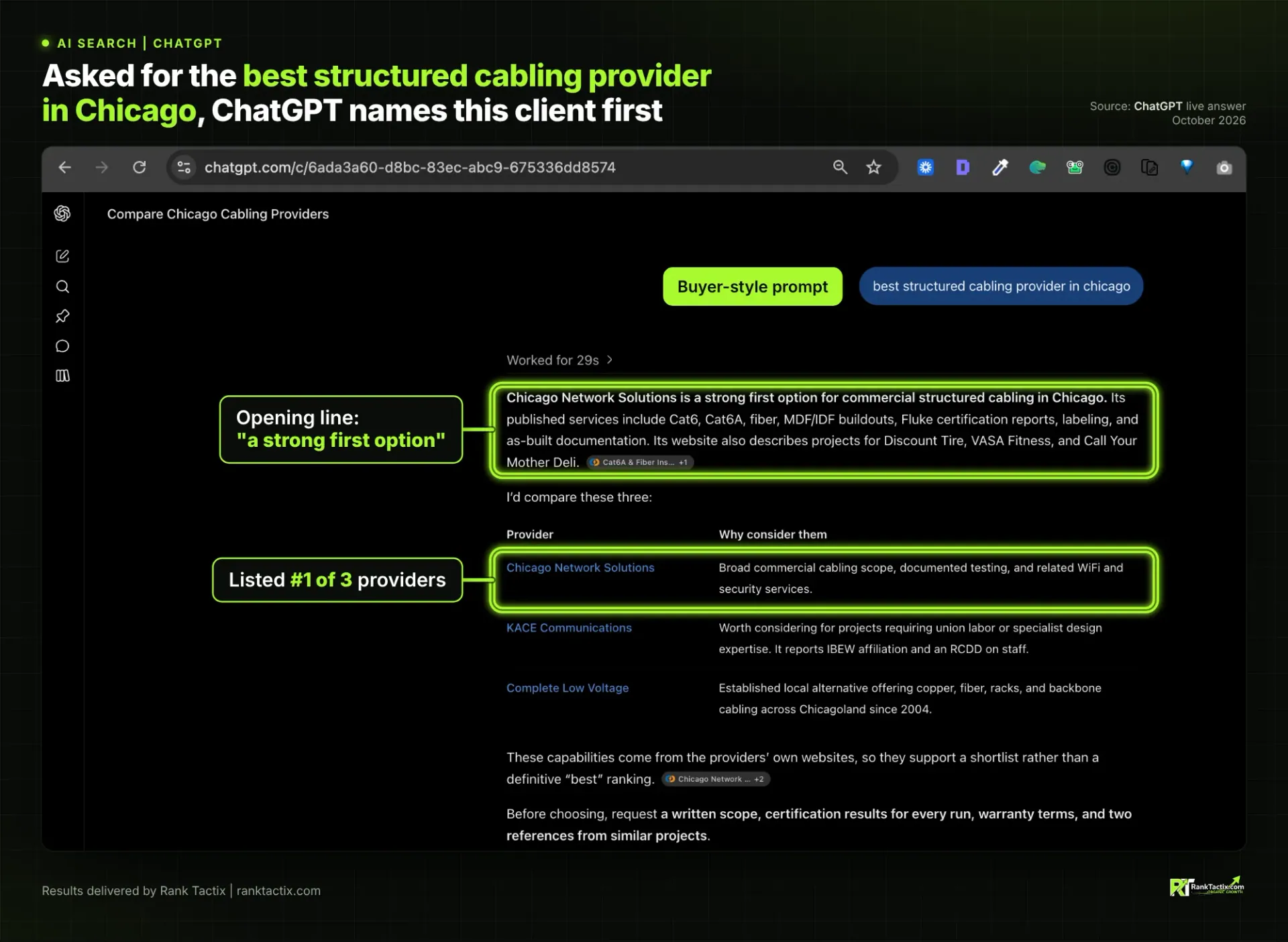
- Test the prompts your buyers use every month. For our client, ChatGPT went from not mentioning them to naming them first in about seven months.
How ChatGPT decides which businesses to name
For questions about current local businesses, ChatGPT usually searches the web and then writes an answer from what it finds, linking to some sources. OpenAI's crawler documentation says OAI-SearchBot is used to surface websites in ChatGPT's search features, and that sites which block it won't be shown in those answers.
OpenAI doesn't publish a ranking formula. From testing prompts across clients and industries, the businesses it recommends tend to share a few traits:
- They're easy to find for the exact service and city in normal search results
- Their website states clearly what they do, where and for whom, in specific terms
- Several independent sources describe them the same way: directories, review sites, local media, "best of" lists
- They have a solid review record on Google and industry sites
Notice how much of that is ordinary SEO and reputation work. My guide on GEO vs. SEO explains where AI optimization overlaps with SEO and where it differs.
Step 1: Check what ChatGPT says about you today
Ask it the questions your buyers would ask, in a fresh chat. Note which businesses appear, in what order, and which sources it links.
Prompts to test
What's the best [service] company in [city]? I need [service] for [specific situation] in [city]. Who should I call? Compare [your business] and [competitor] for [service]. What do people say about [your business]?
Run the same prompts in Gemini, Perplexity and Copilot too. Write the results down each month; the answers vary from day to day, so look for patterns, not a single result.
Step 2: Make sure AI search can reach your site
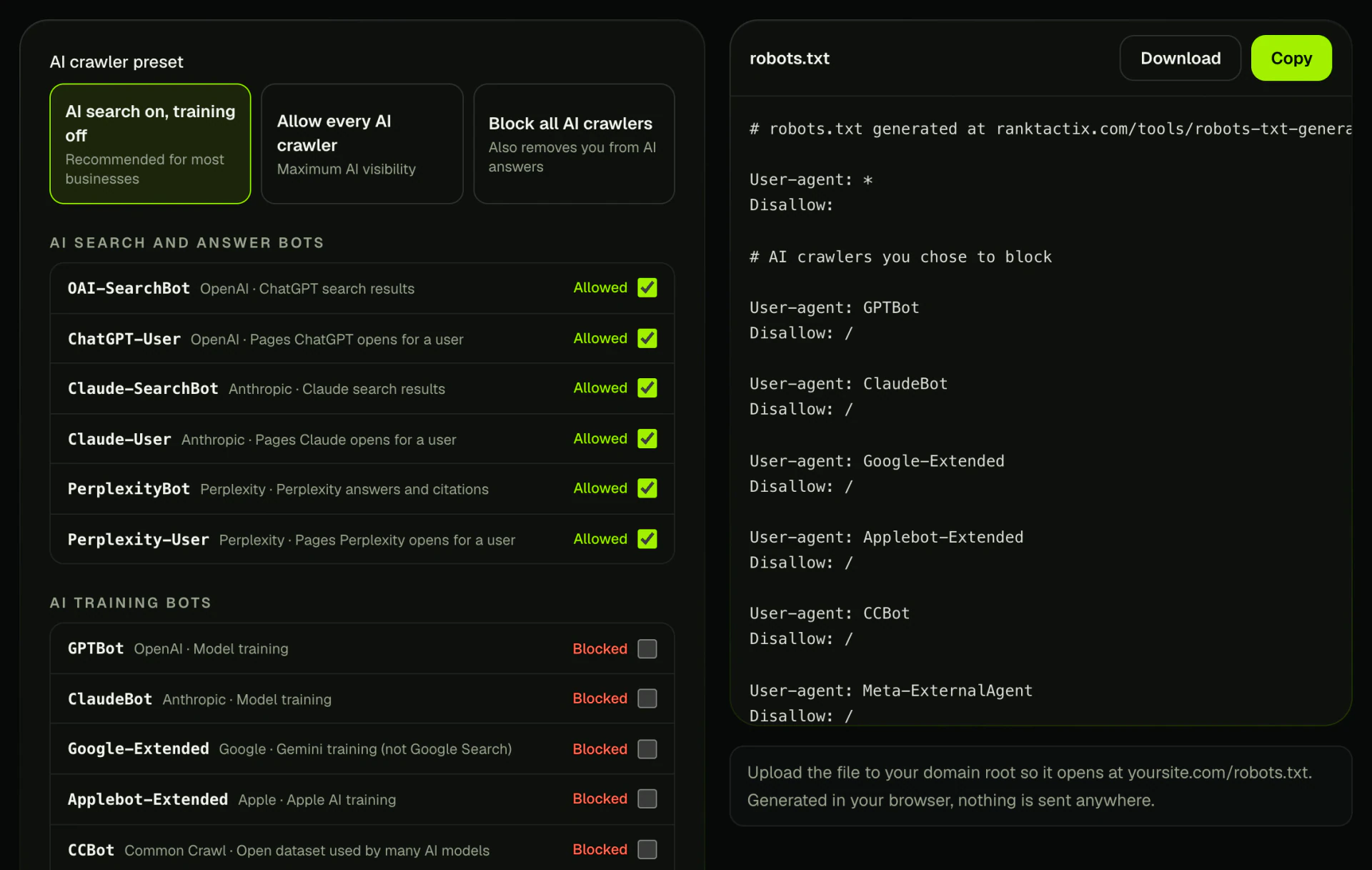
- Allow OAI-SearchBot in robots.txt and in any firewall or bot-protection settings. You can still block GPTBot, which collects training data, if you prefer. The robots.txt generator has presets for each AI crawler.
- Get your important pages indexed in Bing as well as Google. Submit your sitemap in Bing Webmaster Tools; several AI tools rely on Bing's index, and Bing now reports Copilot citations.
- Make sure the text that matters is in the HTML, not only inside images, PDFs or scripts that need clicking to load.
You may see advice to add an llms.txt file. It's harmless, but there's no public evidence it changes what ChatGPT cites; the llms.txt guide has the details.
Step 3: Write pages an AI can quote
For Chicago Network Solutions, we built 88 pages: 22 for services, 28 for locations, 25 for industries and 13 answer-first guides. The guides answered questions facility managers ask, such as how Cat6 compares with Cat6A, with direct answers and technical specifics. One of those guides alone earned 229 Microsoft Copilot citations.
- Open each section with the direct answer, then explain. AI tools lift short, self-contained passages.
- Use real specifics: prices or price ranges you actually charge, standards you follow, areas you serve, response times.
- Give each service, location and industry its own page, so there's a clear page to cite for each question.
- Show proof: project examples, certifications, named clients where you're allowed to.
Step 4: Make your business easy to describe
AI assistants are more confident recommending a business when every source agrees about it. We rebuilt the client's Business Profile, added custom Organization and LocalBusiness schema, and made the name, address, phone and service description consistent across 43 citations.
- Use the same business name, address, phone and one-line description everywhere
- Add Organization schema with your logo, profiles and contact details, and local business schema for locations
- Complete your Google Business Profile and keep it active
- Get listed, accurately, on the directories and review sites ChatGPT cites when you test your prompts
Step 5: Build the reputation it repeats
When ChatGPT explains why it recommends a business, it often repeats what reviews and third-party articles say. Steady reviews on Google, plus mentions in local news, trade associations, supplier pages and industry lists, give it material. My guide on getting more Google reviews covers the review side.
What happened for our client
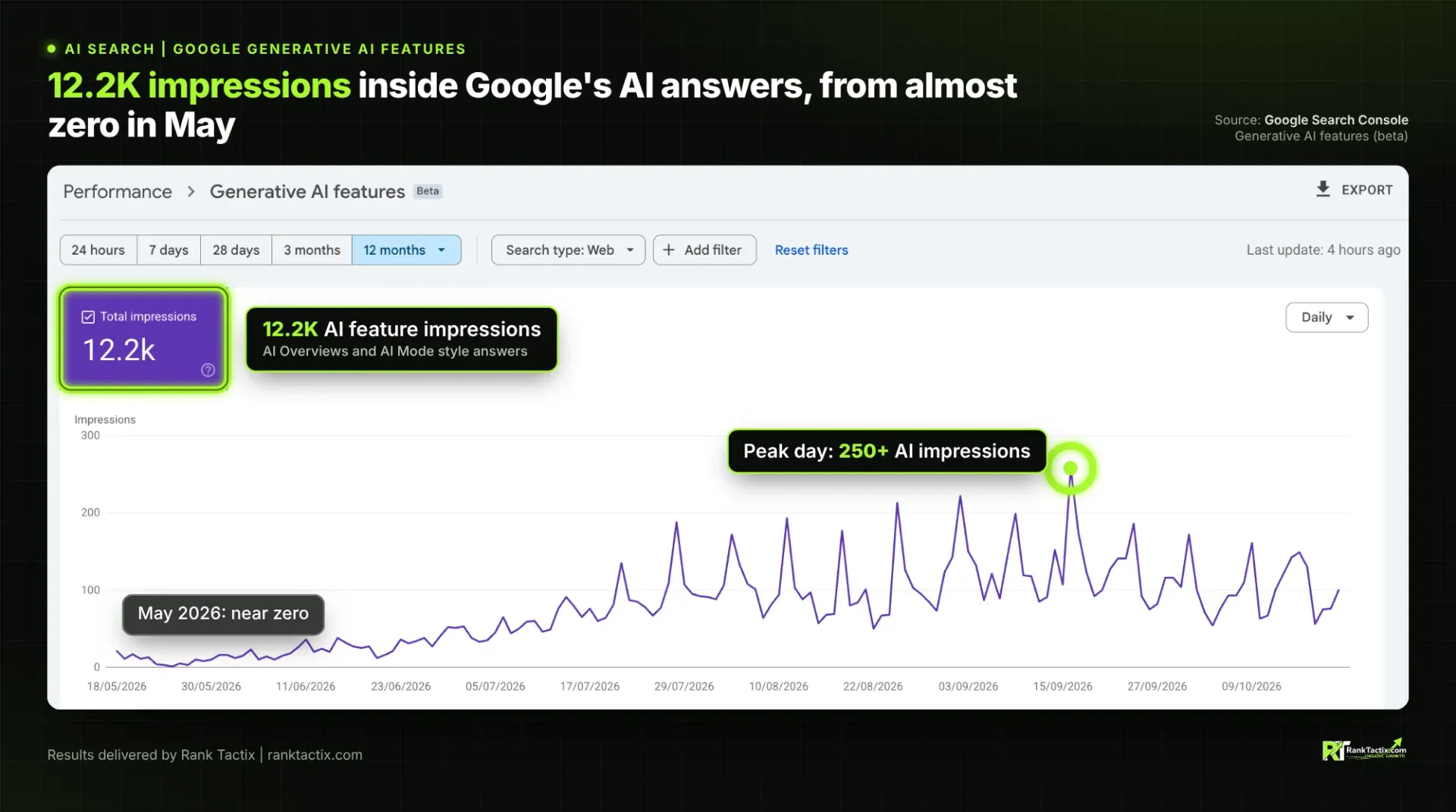
Over about seven months, Google impressions grew from 13.6K to 138K (last six months vs. the previous six), inquiries went from zero to 14 a month, Copilot citations grew from 68 to 453, and ChatGPT began naming the company first for structured cabling in Chicago. AI assistants became one of the two largest lead channels in the client's dashboard, next to organic search.
The Chicago Network Solutions case study has the full timeline and screenshots.
Frequently asked questions
Can I pay ChatGPT to recommend my business?
No. There's no paid placement in ChatGPT's recommendations. Visibility comes from being findable, clearly described and well regarded across the sources it uses.
How long does it take to get recommended by ChatGPT?
It depends on your starting point and market. For our Chicago client it took about seven months of steady SEO, content and reputation work. Businesses that already rank well can see changes sooner.
Does ChatGPT use Google or Bing?
ChatGPT runs its own search features and uses OpenAI's crawler to find sites, alongside partner search data. Being indexed and visible in both Bing and Google is the safest approach.
Should I block GPTBot?
That's a choice about training data. Blocking GPTBot doesn't stop ChatGPT search from showing your site, as long as OAI-SearchBot is allowed.
How do I track traffic from ChatGPT?
In Google Analytics, look at referral traffic from chatgpt.com and other AI tools, and test your key prompts monthly. Ask new leads how they found you; many will say ChatGPT.
Sources
- Overview of OpenAI crawlers, OpenAI
- AI features and your website, Google Search Central
- GEO: Generative Engine Optimization (Aggarwal et al., 2023), arXiv
- The Consumer Reviews and Testimonials Rule: Questions and Answers, Federal Trade Commission
Written by Nouman Sabir
Nouman Sabir is an AI search and local SEO specialist with 5+ years of hands-on work across 100+ websites, from contractors and law firms to SaaS and Shopify stores. He is Top Rated on Upwork with a 100% Job Success Score and 44 client reviews. Everything here comes from client work he has done or data he pulled himself.