
Customer acquisition cost: how to calculate it and use it
Customer acquisition cost is what you spend to win one new customer. It's the number that tells you whether a marketing channel is worth scaling, and it's easy to get wrong by leaving costs out or mixing channels together. Here's the formula, a worked example and how to use it alongside lifetime value.

By Nouman Sabir, AI search & SEO specialist
Updated · 4 min read

The short answer
- CAC = total sales and marketing cost for a period ÷ new customers won in that period.
- Include everything it took to win them: ad spend, agency or SEO fees, tools, and the share of salaries spent on sales and marketing.
- Calculate CAC per channel as well as blended. Channels like SEO cost more up front and less per customer later, so measure them over six to twelve months.
- Judge CAC against what a customer is worth: lifetime value and how many months it takes to earn the CAC back.
The CAC formula
Customer acquisition cost
CAC = (marketing costs + sales costs) ÷ new customers Example (a month): Ads $3,000 + SEO retainer $1,500 + tools $200 + sales time $1,300 = $6,000 New customers: 20 CAC = $6,000 ÷ 20 = $300
Use the same period for costs and customers, and count customers when they actually buy, not when they become leads. Search interest is steady: about 4,400 monthly searches for "customer acquisition cost", 880 for "cac formula" and 720 for "how to calculate customer acquisition cost" (DataForSEO, October 2026).
What to include and leave out
| Include | Leave out |
|---|---|
| Ad spend on all platforms | Costs of serving existing customers |
| Agency, SEO and freelancer fees | Product development |
| Marketing and sales software | General overhead unrelated to acquisition |
| Sales and marketing salaries, or the share of time spent on it | Refunds and churn (track separately) |
| Content, design and event costs |
A small business owner who does their own marketing should still put a value on that time. Otherwise every channel looks cheaper than it is.
Channel CAC vs blended CAC
Blended CAC divides all costs by all new customers. Channel CAC does it per source: search ads, SEO, referrals, outbound. You need both. Blended shows overall health; channel CAC shows where the next dollar should go.
- Track the source of each customer: UTM links on campaigns and profiles (the UTM builder), call tracking and a "how did you hear about us" field
- Measure SEO over a longer window: most of the cost comes before the customers do, so monthly CAC for SEO looks bad early and good later
- Watch referral CAC: often the lowest, and a sign of what's working in delivery
Compare CAC with lifetime value
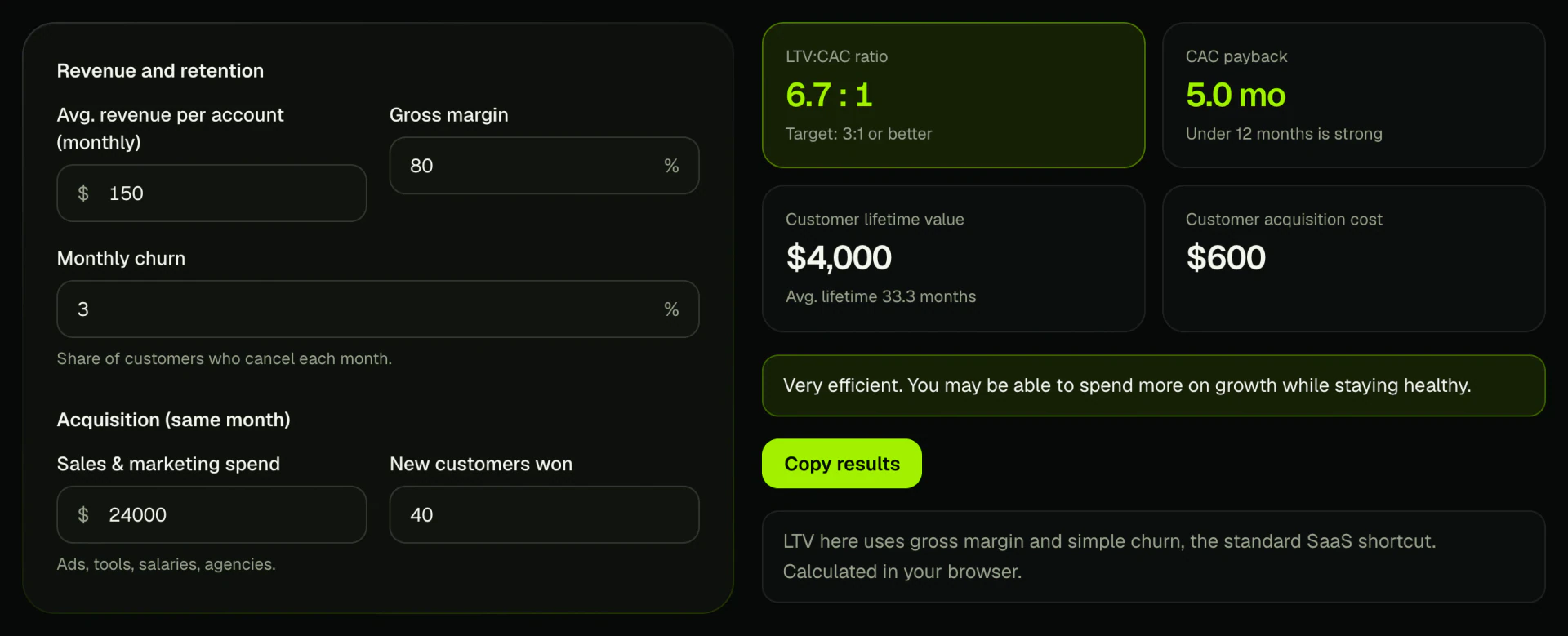
- Lifetime value (LTV): average gross profit per customer over the whole relationship
- LTV:CAC ratio: the calculator uses 3:1 or better as its target; lower means you may be paying too much per customer
- Payback period: months of gross profit needed to earn back the CAC; shorter is safer for cash flow
The LTV:CAC calculator runs this in your browser. For SaaS-specific advice see the SaaS SEO strategy, and for local services, is SEO worth it.
How to lower CAC
- Improve conversion before buying more traffic: faster replies, clearer pages, better offers
- Build channels without a per-click cost, such as organic search, Maps and referrals
- Cut the campaigns with the worst channel CAC, not across the board
- Raise retention, which raises LTV and makes the same CAC more affordable
Frequently asked questions
How do you calculate customer acquisition cost?
Add up sales and marketing costs for a period and divide by the number of new customers won in the same period.
What is a good customer acquisition cost?
It depends on what a customer is worth. A common check is lifetime value at least three times CAC, with a payback period short enough for your cash flow.
Should salaries be included in CAC?
Yes, the share of sales and marketing salaries spent on winning new customers. Leaving them out understates the real cost.
What's the difference between CAC and cost per lead?
Cost per lead counts inquiries; CAC counts paying customers. A cheap lead source with a low close rate can have a high CAC.
How do I calculate CAC for SEO?
Divide SEO costs over six to twelve months by the customers who came from organic search in that period. Short windows overstate SEO's CAC.
Sources
- About conversion measurement, Google Ads Help
- [GA4] Traffic-source dimensions, manual tagging and auto-tagging, Google Analytics Help
- Google keyword data (search volume), DataForSEO, pulled October 2026
Written by Nouman Sabir
Nouman Sabir is an AI search and local SEO specialist with 5+ years of hands-on work across 100+ websites, from contractors and law firms to SaaS and Shopify stores. He is Top Rated on Upwork with a 100% Job Success Score and 44 client reviews. Everything here comes from client work he has done or data he pulled himself.